School Burnout: The Pressure Families Don’t Always Notice Until It’s Gone
- Tasha Louise Cox

- Mar 7
- 4 min read
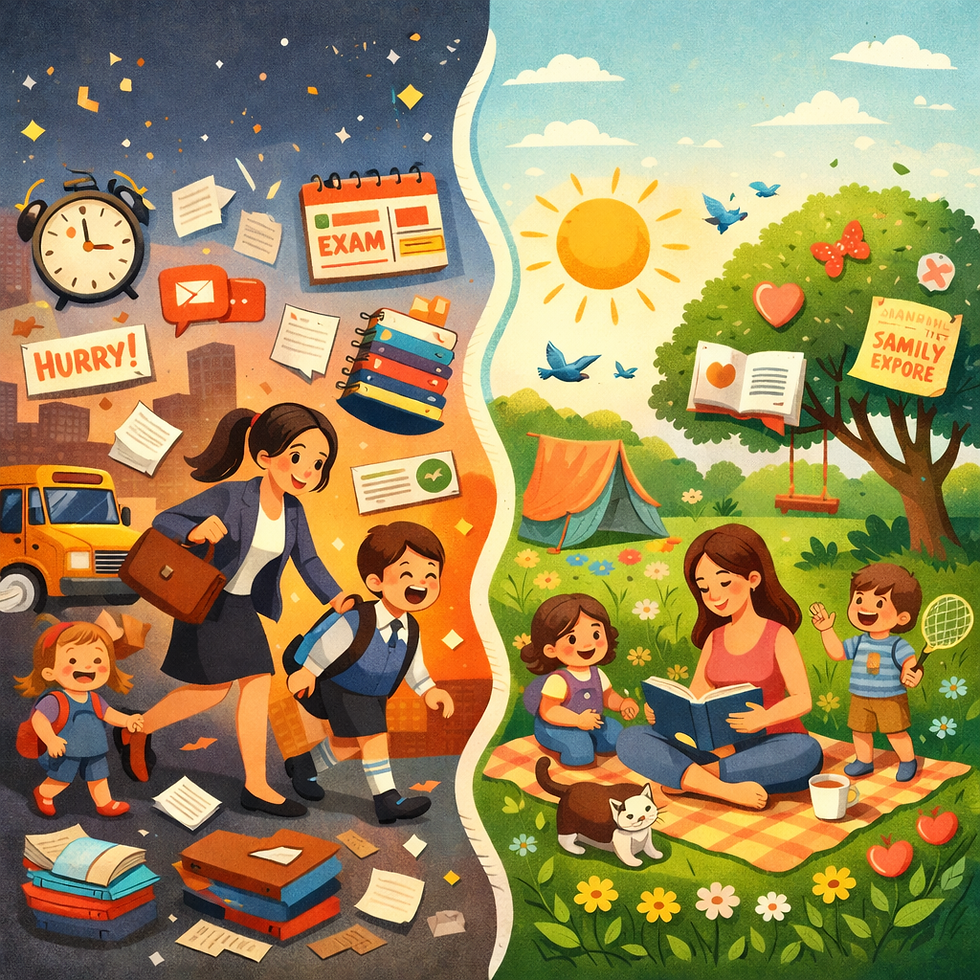
When people talk about school burnout, they usually mean the children. The tiredness, the stress around exams, the reluctance to get out of bed in the morning. But something I didn’t fully see until much later is that school burnout doesn’t just belong to children — it quietly seeps into the whole family.
Interestingly, this realisation didn’t lead me to home educate. My decision to home educate came from many other reasons. But stepping away from the traditional school system revealed something I hadn’t noticed while we were in it: just how much pressure school had placed on our entire household.
When you’re in it, it all feels normal.
The constant emails. Messages, reminders, forms, events and updates that never quite stop. Alongside them comes the quiet pressure of managing the social side of school life too — navigating friendship issues, worrying about who is getting along with who, and trying to coordinate after-school playdates so children feel included and connected.
Homework that needs supervising after already busy days. Uniforms that must be washed, dried and ready for the next morning. The never-ending reel of school events, reminders, trips and deadlines.
It becomes a background hum in family life.
Then there’s attendance. The worry about sick days. The internal calculation about whether a child is “well enough” to go. The pressure of knowing absences are monitored and judged.
Add to that the daily rush.
Getting everyone up.
Breakfast eaten quickly.
Shoes found.
Bags packed.
Out the door by a certain time, whether the morning energy in the house supports that rhythm or not.
For many families, the start and end of the day can become flashpoints. Parents repeating instructions. Children resisting or melting down. Tension building before the day has even properly begun.
Even evenings aren’t always calmer. Bedtimes are often rushed because tomorrow is another early start. Everyone is trying to reset quickly enough to do it all again.
What I didn’t see clearly at the time was how this rhythm affects the family nervous system.
When every weekday runs on urgency and obligation, it creates a subtle but constant pressure. Parents are managing logistics, expectations, and emotional regulation — their own and their children’s — often all before 9am.
School becomes a pressure point that radiates into family life.
Even the school holidays — something families often look forward to — can become another source of pressure. There can be an unspoken expectation to make them “special,” to fit in trips, activities and experiences because this is the time you finally have together. At the same time, parents are often trying to keep work going in ways that fit around school hours but rarely fit around long holidays. Instead of rest, holidays can become a juggling act of childcare, work commitments, financial pressure and the desire to create meaningful family time. The system expects parents to mould their work around the school day, yet offers very little flexibility when that same system pauses for weeks at a time.
And it raises a bigger question — perhaps work should be shaped around family life, around our children, rather than families constantly bending themselves around a system designed to keep them separate for most of the day. For many parents, especially mothers, there can be a quiet grief in how much time and connection the structure of school removes from daily family life.
Another realisation that came with stepping away was how much we have come to outsource learning. For most of human history, learning was simply woven into childhood — much like learning to walk, talk, or use the toilet. It happened naturally through being part of family life and the world around us. Yet in modern society we’ve come to believe education must be delivered by institutions, by professionals, in buildings separate from the home. Success only coming from exam results - pieces of paper.
In doing so, many parents unknowingly hand over something that once belonged naturally within the family. Reclaiming that parental responsibility can feel daunting, but it can also be deeply empowering. In many ways, taking responsibility for our children’s learning is simply about getting our children back — bringing learning back into the everyday fabric of family life.
This isn’t about blaming teachers or schools. Most are doing their best within a system that demands structure, attendance targets, performance measures and timetables that rarely bend around individual families.
But the system itself is intense.
And when you’re inside it, you adapt. You cope. You normalise the stress because everyone else seems to be doing the same thing.
It was only when we stepped away that I realised how much calmer our household nervous system became. Mornings softened. Evenings felt less like a countdown clock. The daily sense of urgency lifted in a way I hadn’t realised we were carrying.
Again, home education wasn’t chosen because of burnout. But it did expose something important: how much pressure the standard school rhythm can place on families.
For many parents and children, school works beautifully and provides structure, community and opportunity.
But it’s also okay to acknowledge that the pace and demands of the system can quietly stretch families thin.
Another layer to this is the strong societal expectation that the traditional school path is the only “normal” or acceptable option. For many parents, even questioning that path can feel uncomfortable. There are real concerns — finances, work schedules, social expectations, and the fear of stepping outside what most people do. These obstacles are valid. But often we focus so much on the constraints society places around us that we stop looking for possible solutions. Sometimes there are more options than we initially allow ourselves to see.
Choosing a different path doesn’t mean it will be easy, but it can mean it is more aligned with your family’s needs. Home education isn’t the right choice for everyone, but for some families it can be one of the most freeing things you will ever do.
Sometimes we don’t see the weight of something until we’re no longer carrying it — and realise the system we were following was no longer serving the wellbeing of our children, us as parents and certainly not for the family unit as a whole.
Written by Tasha Cox


Comments